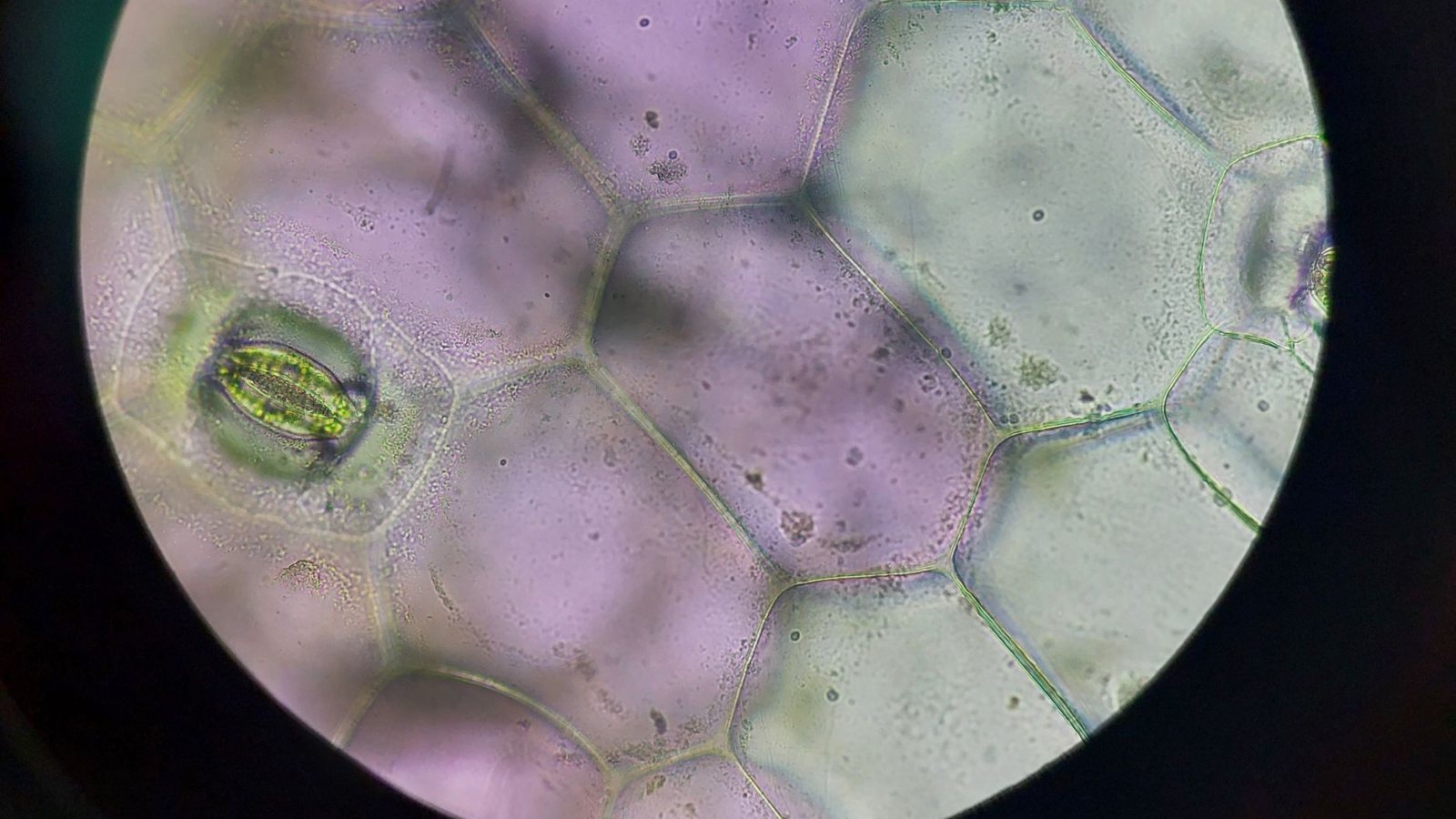
If light powers photosynthesis, why do plants close their stomata even on a sunny afternoon? A leaf needs carbon dioxide from the air, but the same pores that let carbon dioxide in also let water vapor out. When the roots and stem cannot supply water as fast as the leaf loses it, narrowing those pores can slow the loss. The leaf may still have plenty of light, yet take in less of the carbon dioxide it needs to make sugars.
A stoma is a tiny pore in the epidermis, the outer cell layer of a leaf. Stomata is the plural. Many land plants have stomata on the lower surface of their leaves, though their location varies among species. Each pore connects the outside air to air spaces among the cells inside the leaf.
During active photosynthesis, cells use carbon dioxide, or CO2, helping keep its concentration lower inside the leaf than in the surrounding air. CO2 diffuses inward down that concentration gradient. At the same time, water evaporates from moist cell walls inside the leaf. When the air outside is drier than the air inside, water vapor diffuses outward. The loss of water vapor from a plant is called transpiration.
The pore does not sort the gases or send them in one direction. Each gas moves down its own gradient. A narrower opening makes diffusion through the pore harder for both. That is why the leaf cannot simply shut off water loss through a stoma while leaving CO2 entry through that same pore unchanged.
Two guard cells flank each pore. In many plants, these cells look like a pair of curved beans when viewed from above. To open the pore, guard cells accumulate dissolved substances, including potassium ions. This lowers their water potential, so water moves into them by osmosis. The incoming water raises turgor pressure, the pressure of the cell contents against the cell wall.
Higher pressure does not simply make the guard cells swell into the gap. Their walls differ in thickness and in how readily they stretch in different directions. In the familiar bean-shaped pair, the cells bow apart as their turgor rises, widening the opening. When dissolved substances leave the guard cells, water can follow. Turgor falls, the cells bow less, and the pore narrows. The drawing of an open stoma in OpenStax Biology 2e shows the gap between the two cells.
A leaf does not need to wilt visibly before its stomata respond. During water stress, the plant hormone abscisic acid, often shortened to ABA, can trigger changes in guard cell ion transport that promote closure. The signal changes what crosses the guard cell membranes, and the change in water content supplies the movement.
Water supply is only half of the problem. The other half is how fast the air draws water vapor from the leaf. Think of a plant in moist soil on a hot, dry afternoon. If the air inside a leaf is moist and the surrounding air is much drier, water vapor can escape rapidly through open stomata. Even with water available in the soil, the roots and stem may not deliver it fast enough to keep up. Depending on the species and conditions, stomata can narrow in response to dry air.
Dry soil can create a similar problem from the supply side. As soil dries, the roots generally have a harder time taking up water. Narrowing the stomata reduces water loss and can help leaf cells retain turgor. Closure need not be complete: a partly open pore can still admit some CO2 while letting less water vapor out than a wider pore would under the same conditions.
This also explains why a sunny afternoon is not always better for photosynthesis than a cooler morning. Light supplies energy, but it cannot replace CO2 as a source of carbon. If CO2 enters more slowly while photosynthetic cells are still using it, the supply inside the leaf can fall and limit how fast those cells fix carbon.
Imagine comparing two similar leaves from plants of the same species under the same light and at the same leaf temperature. One plant has been watered regularly; the other has had less water. If the second leaf has narrower stomata and takes up less CO2, that fits the idea that closure restricts photosynthesis. But those observations alone do not show that narrower pores account for the whole decrease. More severe water stress can also affect the reactions inside the leaf that use CO2.
A useful comparison would be to raise the CO2 concentration of the air around the water-stressed leaf while keeping the light and temperature unchanged, and to monitor stomatal opening. If CO2 uptake rises while the pores remain just as narrow, that supports the idea that delivery of CO2 was limiting uptake. A higher concentration outside the leaf can drive more CO2 through the same narrow openings. It does not have to make the openings wider to do so.
Water loss needs its own measurement or prediction. A leaf with narrower stomata is not guaranteed to lose less water than another leaf measured in much more humid air. To attribute a difference in water loss to pore width, compare leaves under similar conditions, including humidity, leaf temperature, and airflow. The guide to identifying variables in biology experiments can help separate the factor being changed from the conditions that need to stay the same.
Picture a leaf at a steady temperature. The surrounding air suddenly gets drier, but for this thought experiment the pore width does not change at first. Predict what happens to water loss before the guard cells respond. Then predict what happens after the pores narrow, assuming the air remains just as dry.
At first, water loss rises because the difference in water vapor concentration between the leaf interior and the outside air is larger. After the pores narrow, water loss drops compared with what it would be if the pores had stayed wide in that dry air. That second comparison does not tell you whether water loss has returned to its original rate. For that, you would need to know how much the air dried and how much the pores narrowed. For more exercises that ask you to track which conditions change, see the IBioC training and practice problems.
Do closed stomata stop all water loss?
No. Narrowing or closing stomata reduces water loss through the pores, but some water can still escape through the leaf's waxy cuticle.
Does closing stomata stop photosynthesis immediately?
No. A partly closed pore can still admit carbon dioxide, and the leaf can use carbon dioxide already inside it. If the supply stays low, the rate of photosynthesis can fall.
Are guard cells the same thing as stomata?
No. A stoma is the opening, and the two guard cells on its sides control its width.
About the International Biology Competition: an online biology competition for high school students from around the world. How the rounds work